AI Reading Retina Scans: Copilot for Eye Doctors, Not a Replacement
A clinical trial found that an AI copilot improved ophthalmologists' diagnostic accuracy on challenging eye cases. Here is what that means for patients in Jaipur.
Book an Eye Examination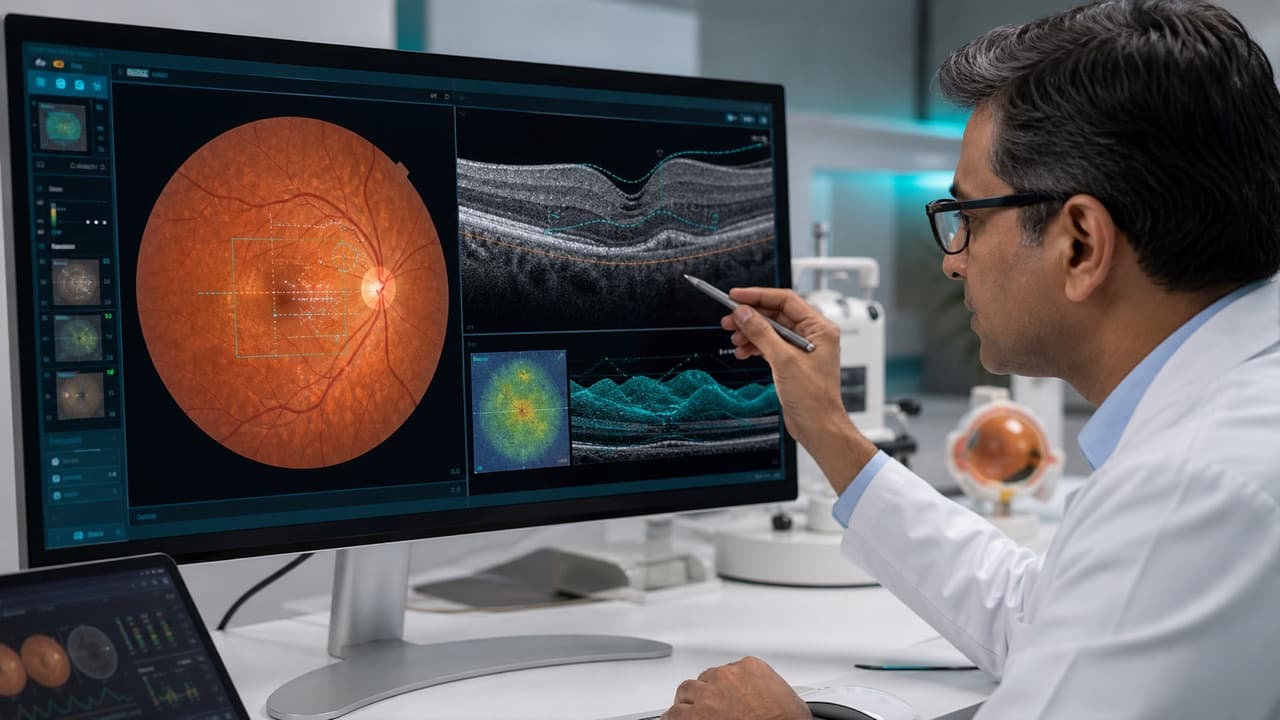
The result that caught attention
A randomized clinical trial published in Nature Medicine evaluated EyeFM, an AI foundation-model copilot for ophthalmology. On the study's challenging cases, ophthalmologists assisted by the system achieved a 92.2% correct diagnostic rate compared with 75.4% without the copilot.
The useful word is assisted. Doctors still interpreted the case, considered the AI output, and made the decision. The study did not hand autonomous control of diagnosis or treatment to a machine.
The trial also tested a defined research setting. Performance in routine clinics depends on image quality, patient population, disease mix, hardware, workflow, and how safely the tool is integrated.
Where AI may genuinely help
Eye care produces image-rich data: retinal photographs, OCT scans, corneal maps, visual fields, and lens measurements. AI can help flag subtle patterns, compare large amounts of information, and prompt a clinician to consider diagnoses that might otherwise be overlooked.
It may be especially valuable for triage, diabetic-retinopathy screening, rare-disease pattern recognition, and giving specialists a structured second look.
But an algorithm cannot feel eye pain, examine the front of the eye, understand every medication, discuss uncertainty compassionately, or take responsibility for a surgical plan.
The Kabra Eye Hospital principle
Advanced diagnostics should strengthen doctor judgement, not replace it. At Kabra Eye Hospital Jaipur, scans and measurements are useful when they connect to examination, counselling, and follow-up.
Patients should be cautious of services claiming that one photograph or instant AI score proves the eye is healthy. A screening result is a starting point, especially for diabetes, glaucoma, macular disease, retinal symptoms, or unexplained vision loss.
Research-aware care means adopting evidence carefully, validating tools in real patients, protecting privacy, and keeping a qualified ophthalmologist accountable for the final decision.
Quick Answers
Can AI replace an ophthalmologist?
No. AI can organize images and suggest possibilities, but examination quality, clinical context, treatment choice, consent, and responsibility still require trained eye-care professionals.
What did the EyeFM trial show?
In the published randomized trial, ophthalmologists using the AI copilot achieved a higher correct diagnostic rate on the study cases than those working without it.
Does a normal AI screening result guarantee healthy eyes?
No. Every screening system can miss disease, and some conditions require pressure measurement, dilated examination, OCT, visual fields, corneal testing, or repeated follow-up.
Read the evidence behind this explainer
These links lead to the regulator, peer-reviewed journal, or research institution used for this article. Kabra Eye Hospital has summarized the findings and limits in patient-friendly language.
The cited system is a research AI copilot. This article does not claim that EyeFM is deployed at Kabra Eye Hospital or approved for autonomous diagnosis.