
Can Two Hours Outdoors Protect Children From Myopia? What Research Actually Shows
A practical Jaipur parent guide to outdoor time and childhood myopia, based on recent systematic reviews rather than social-media promises.
Book an Eye Examination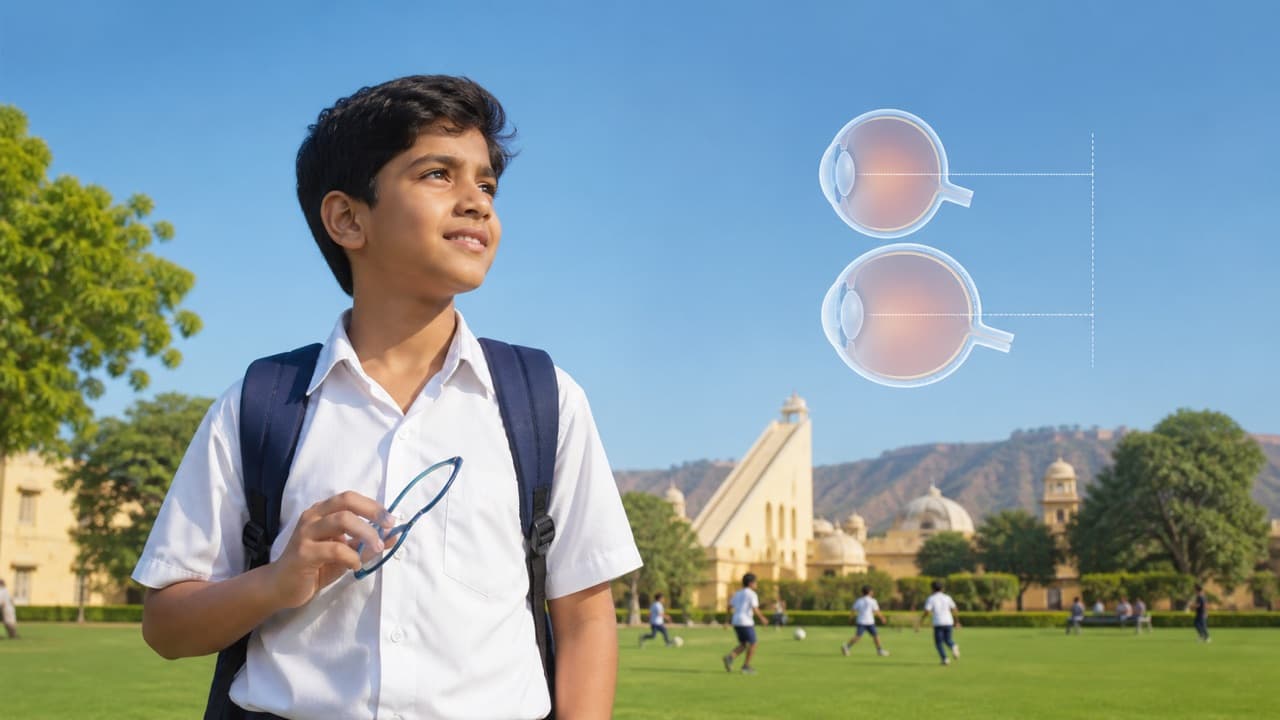
What the evidence supports
A 2025 meta-analysis of 15 studies involving 16,597 children found that school-based outdoor interventions were associated with a lower risk of developing myopia and a delay in myopia onset. Programs in the included studies added roughly 40 to 120 minutes outdoors per day.
The direction of evidence is useful, but the authors rated certainty as low because studies differed and had risk of bias. Parents should hear both parts: outdoor time is a sensible preventive habit, and it is not a guaranteed shield.
Outdoor light may help regulate eye growth, while outdoor activity also creates breaks from continuous close work. Children should never look directly at the sun, and UV protection remains sensible in strong Jaipur sunlight.
What outdoor time cannot do
Once a child is already myopic, outdoor time alone does not reliably stop progression or reverse the prescription. The child still needs an accurate refraction, glasses when prescribed, and follow-up to measure change.
Depending on age and progression, an ophthalmologist may discuss evidence-based myopia-control options. These require individual assessment and are not substitutes for outdoor habits, comfortable reading distance, good lighting, and regular breaks.
The popular 20-20-20 rule can help visual comfort during near work, but it is not proven to cure myopia.
A practical Jaipur family plan
Build outdoor time into mornings or later afternoons when Jaipur heat and UV exposure are more manageable. Choose play, walking, cycling, or sports instead of treating the recommendation as another screen-time timer.
Arrange an eye examination if a child squints, sits close to television, copies incorrectly from the board, complains of headaches, rubs the eyes, tilts the head, or shows a drop in school performance.
Kabra Eye Hospital's child-eye care pathway combines refraction, binocular-vision assessment, squint evaluation when needed, and follow-up based on the child's growth and prescription trend.
Quick Answers
Can outdoor play reverse a child's minus number?
No. Outdoor time can reduce the chance that myopia begins, but it does not reliably erase an established prescription. Existing myopia still needs correction and monitoring.
How much outdoor time should children get?
Recent reviews support increasing daily outdoor exposure, often around 40 to 120 minutes in the studied programs. A practical family target is about two hours outdoors daily when weather, safety, and health permit.
Are phones the only cause of childhood myopia?
No. Genetics, intensive near work, limited outdoor time, schooling patterns, and environment all contribute. Blaming one device oversimplifies the problem.
Read the evidence behind this explainer
These links lead to the regulator, peer-reviewed journal, or research institution used for this article. Kabra Eye Hospital has summarized the findings and limits in patient-friendly language.
Outdoor time is a preventive health habit, not a cure for established myopia. Individual assessment remains important.